Summary
MCARD envisions an initiative encompassing technology development and clinical collaboration, with the goal of finding therapies that treat multiple diseases of aging at once and giving them a validated path to approval.
At the heart of MCARD’s mission is the search for biomarkers that measure the biology driving age-related diseases such as cancer, stroke, and Alzheimer’s disease.
MCARD aims to include these biomarkers in every United States clinical trial in order to evaluate the potential of new disease treatments to target multiple diseases of aging.
The world is aging…
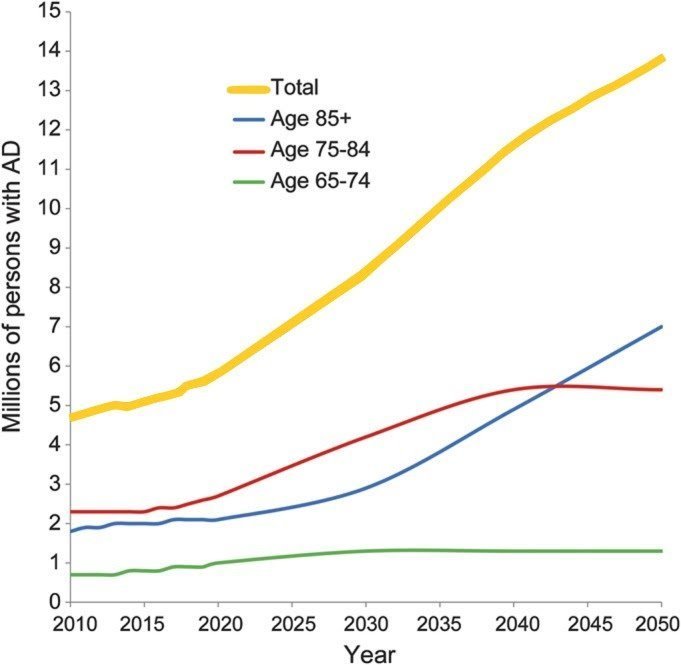
By 2029, the United States is projected to have more old (65+) people than children [1], and the global elderly population will double current numbers by 2050 [2]. Advanced age is the greatest risk factor for most severe disease outcomes in developed countries, including neurodegeneration, cancer, and COVID-19 [3, 4]. The number of people living with dementia worldwide is expected to nearly triple by 2050 [5], as is the number of Americans with Alzheimer’s disease dementia (Figure 1) [6], and similar projections for other symptoms and diseases of aging add up to a terrifying healthcare burden: two thirds of the ballooning 65+ population suffer from two or more chronic diseases at the time of writing [7], and patients with multiple diseases account for up to 78 percent of primary care consultations [8]. Eliminating these age-related diseases is essential for ensuring a healthier and more capable society moving forward.
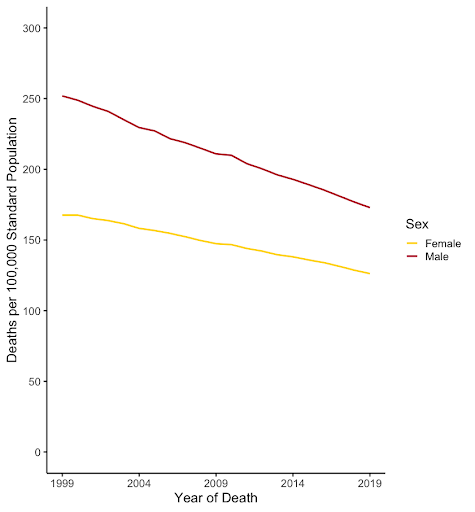
Disease-focused initiatives have shown that though biology is complicated, concerted human effort does allow us to influence how it affects us. For example, the decades-long national push to advance cancer research, which has stretched from the National Cancer Act (1971) to the Cancer Moonshot (2016), has raised five-year cancer survival from 49 percent in the mid-1970s to 70 percent today [9].
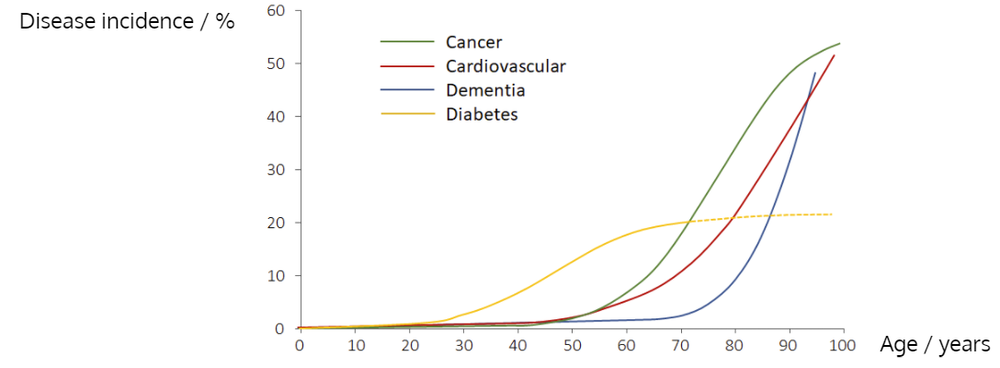
While such improvements are certainly meaningful, even focused initiatives to tackle specific diseases take time to impact the population (Figure 2). Further, multimorbidity—the presence of multiple diseases or conditions—is so prevalent at advanced age that curing a common disease like cancer would not dramatically reduce the population’s overall disease burden: eliminating all cancer deaths would add only about three years to U.S. life expectancy at birth [10]. We intuitively know, and can observe from the incidence of major diseases with age (Figure 3), that young people don’t typically get heart attacks, dementia, or cancer, while older people get them all—and often more than one at a time. The prevalence and non-random clustering of multimorbidity in older people suggest that the risks of age-related diseases are not independent [11]. This interdependence of age-related diseases could be due to one or more shared drivers of disease. As such, tackling disease targets on a “one-by-one” basis may not be an optimal strategy for significantly addressing the growing healthcare burden within the next few decades.
The MCARD strategy
The MCARD strategy envisions an alternative approach to identifying therapeutics: mobilizing every United States clinical trial to find therapies that are effective against multiple age-related diseases. Semaglutide, a GLP-1 drug first approved for type 2 diabetes in 2017, is one such therapy: separate large trials have since found that it reduces heart attacks, strokes and cardiovascular deaths [16], slows chronic kidney disease [17], and treats fatty liver disease [18], with each benefit confirmed years after its first approval.
Achieving this goal will involve including in every clinical trial non-invasive biomarkers that measure a given drug’s effects on the biological mechanisms coupling the occurrence of multiple age-related diseases. We call these biomarkers “mechanistic” biomarkers: they measure the biology driving disease, rather than biology that is caused by or correlated with disease. (High) blood pressure and (high) cholesterol are examples of successful mechanistic biomarkers: blood pressure predicts the incidence of multiple cardiovascular diseases, kidney failure, and retinal disease [19–21], and cholesterol predicts ischemic heart disease [22]. Because these biomarkers measure the biology that drives disease outcomes, they have evolved into surrogate endpoints [23]: changing the biomarkers demonstrably affects disease outcomes [24, 25].
The same path remains open for new biomarkers: in 2025, the FDA qualified change in hip bone mineral density as a surrogate endpoint for fractures in osteoporosis drug trials, based on data from more than 160,000 participants in 52 past clinical trials [26]. This was possible because bone mineral density had been measured alongside fractures in dozens of trials.
The past two decades of geroscience research have demonstrated that we can target with interventions the biological mechanisms that drive aging [27, 28]. These mechanisms, which include clonal hematopoiesis (the age-related expansion of mutated blood stem cells) [29], chronic inflammation, immune system weakening, declining mitochondrial function, and loss of muscle, among other things, are promising leads for mechanistic biomarker development.
Because the number of such biological mechanisms is much smaller than the number of diseases that could afflict an individual, researchers could measure a drug’s impact on each mechanism using small fluid samples collected during existing clinical trials, thus eliminating the need to measure clinical endpoints for every possible disease. Blood proteomics can already measure thousands of proteins in a single small sample, and in more than 50,000 UK Biobank participants, over 650 of these proteins were each associated with at least 50 diseases [30].
Aims
In summary, MCARD proposes to address the impending epidemic of age-related multimorbidity in the United States and worldwide via a novel approach to clinical trials: by mobilizing every clinical trial to evaluate a therapy’s potential to treat multiple diseases at once, and doing so by measuring during every clinical trial a set of biological mechanisms that couple multiple age-related diseases. To enable this outcome, MCARD aims to:
- Facilitate the coalitions necessary for developing clinical-grade, minimally invasive biomarkers for interpretable mechanisms of age-related decline;
- Spearhead the initial clinical trials to validate these mechanistic biomarkers as surrogate endpoints; and
- Orchestrate the necessary institutional infrastructure and political mandate to accomplish MCARD’s core goal.
References
- U.S. Census Bureau (2023). U.S. population projected to begin declining in second half of century [2023 National Population Projections, press release]. https://www.census.gov/newsroom/press-releases/2023/population-projections.html
- United Nations, Department of Economic and Social Affairs, Population Division (2022). World Population Prospects 2022: Summary of Results. UN DESA/POP/2022/TR/NO. 3. https://www.un.org/development/desa/pd/sites/www.un.org.development.desa.pd/files/wpp2022_summary_of_results.pdf
- Niccoli, T., & Partridge, L. (2012). Ageing as a risk factor for disease. Current Biology, 22(17), R741–R752. https://doi.org/10.1016/j.cub.2012.07.024
- Levin, A. T., Hanage, W. P., Owusu-Boaitey, N., Cochran, K. B., Walsh, S. P., & Meyerowitz-Katz, G. (2020). Assessing the age specificity of infection fatality rates for COVID-19: systematic review, meta-analysis, and public policy implications. European Journal of Epidemiology, 35(12), 1123–1138. https://doi.org/10.1007/s10654-020-00698-1
- GBD 2019 Dementia Forecasting Collaborators (2022). Estimation of the global prevalence of dementia in 2019 and forecasted prevalence in 2050: an analysis for the Global Burden of Disease Study 2019. The Lancet Public Health, 7(2), e105–e125. https://doi.org/10.1016/S2468-2667(21)00249-8
- Hebert, L. E., Weuve, J., Scherr, P. A., & Evans, D. A. (2013). Alzheimer disease in the United States (2010–2050) estimated using the 2010 census. Neurology, 80(19), 1778–1783. https://doi.org/10.1212/WNL.0b013e31828726f5
- Centers for Medicare & Medicaid Services (2012). Chronic Conditions among Medicare Beneficiaries, Chartbook, 2012 Edition. Baltimore, MD. https://www.cms.gov/research-statistics-data-and-systems/statistics-trends-and-reports/chronic-conditions/downloads/2012chartbook.pdf
- Salisbury, C., Johnson, L., Purdy, S., Valderas, J. M., & Montgomery, A. A. (2011). Epidemiology and impact of multimorbidity in primary care: a retrospective cohort study. British Journal of General Practice, 61(582), e12–e21. https://doi.org/10.3399/bjgp11X548929
- American Cancer Society (2026). Cancer Facts & Figures 2026. Atlanta: American Cancer Society.
- Arias, E., Heron, M., & Tejada-Vera, B. (2013). United States life tables eliminating certain causes of death, 1999–2001. National Vital Statistics Reports, 61(9). Hyattsville, MD: National Center for Health Statistics. https://www.cdc.gov/nchs/data/nvsr/nvsr61/nvsr61_09.pdf
- Prados-Torres, A., Calderón-Larrañaga, A., Hancco-Saavedra, J., Poblador-Plou, B., & van den Akker, M. (2014). Multimorbidity patterns: a systematic review. Journal of Clinical Epidemiology, 67(3), 254–266. https://doi.org/10.1016/j.jclinepi.2013.09.021
- Centers for Disease Control and Prevention, Division of Cancer Prevention and Control (2022). An Update on Cancer Deaths in the United States. Atlanta, GA: U.S. Department of Health and Human Services. https://stacks.cdc.gov/view/cdc/119728
- Mozaffarian, D., Benjamin, E. J., Go, A. S., et al. (2015). Heart disease and stroke statistics—2015 update: a report from the American Heart Association. Circulation, 131(4), e29–e322. https://doi.org/10.1161/CIR.0000000000000152
- Alzheimer’s Association (2017). 2017 Alzheimer’s disease facts and figures. Alzheimer’s & Dementia, 13(4), 325–373. https://doi.org/10.1016/j.jalz.2017.02.001
- International Diabetes Federation (2013). IDF Diabetes Atlas, 6th edition. Brussels: International Diabetes Federation.
- Lincoff, A. M., Brown-Frandsen, K., et al. (2023). Semaglutide and cardiovascular outcomes in obesity without diabetes. New England Journal of Medicine, 389(24), 2221–2232. https://doi.org/10.1056/NEJMoa2307563
- Perkovic, V., Tuttle, K. R., Rossing, P., et al. (2024). Effects of semaglutide on chronic kidney disease in patients with type 2 diabetes. New England Journal of Medicine, 391(2), 109–121. https://doi.org/10.1056/NEJMoa2403347
- Sanyal, A. J., Newsome, P. N., Kliers, I., et al. (2025). Phase 3 trial of semaglutide in metabolic dysfunction–associated steatohepatitis. New England Journal of Medicine, 392(21), 2089–2099. https://doi.org/10.1056/NEJMoa2413258
- Rapsomaniki, E., Timmis, A., George, J., et al. (2014). Blood pressure and incidence of twelve cardiovascular diseases: lifetime risks, healthy life-years lost, and age-specific associations in 1·25 million people. The Lancet, 383(9932), 1899–1911. https://doi.org/10.1016/S0140-6736(14)60685-1
- Klag, M. J., Whelton, P. K., Randall, B. L., Neaton, J. D., Brancati, F. L., Ford, C. E., Shulman, N. B., & Stamler, J. (1996). Blood pressure and end-stage renal disease in men. New England Journal of Medicine, 334(1), 13–18. https://doi.org/10.1056/NEJM199601043340103
- Wong, T. Y., & Mitchell, P. (2004). Hypertensive retinopathy. New England Journal of Medicine, 351(22), 2310–2317. https://doi.org/10.1056/NEJMra032865
- Prospective Studies Collaboration: Lewington, S., Whitlock, G., Clarke, R., et al. (2007). Blood cholesterol and vascular mortality by age, sex, and blood pressure: a meta-analysis of individual data from 61 prospective studies with 55 000 vascular deaths. The Lancet, 370(9602), 1829–1839. https://doi.org/10.1016/S0140-6736(07)61778-4
- U.S. Food and Drug Administration. Table of Surrogate Endpoints That Were the Basis of Drug Approval or Licensure. https://www.fda.gov/drugs/development-resources/table-surrogate-endpoints-were-basis-drug-approval-or-licensure
- Blood Pressure Lowering Treatment Trialists’ Collaboration (2021). Pharmacological blood pressure lowering for primary and secondary prevention of cardiovascular disease across different levels of blood pressure: an individual participant-level data meta-analysis. The Lancet, 397(10285), 1625–1636. https://doi.org/10.1016/S0140-6736(21)00590-0
- Cholesterol Treatment Trialists’ (CTT) Collaboration (2010). Efficacy and safety of more intensive lowering of LDL cholesterol: a meta-analysis of data from 170,000 participants in 26 randomised trials. The Lancet, 376(9753), 1670–1681. https://doi.org/10.1016/S0140-6736(10)61350-5
- Foundation for the National Institutes of Health (2025, December 19). FNIH announces FDA qualification of first surrogate endpoint for use in osteoporosis clinical trials [press release]. https://fnih.org/press-release/fda-qualification-first-surrogate-endpoint-osteoporosis-clinical-trials/
- Harrison, D. E., Strong, R., Sharp, Z. D., et al. (2009). Rapamycin fed late in life extends lifespan in genetically heterogeneous mice. Nature, 460(7253), 392–395. https://doi.org/10.1038/nature08221
- Baker, D. J., Wijshake, T., Tchkonia, T., LeBrasseur, N. K., Childs, B. G., van de Sluis, B., Kirkland, J. L., & van Deursen, J. M. (2011). Clearance of p16Ink4a-positive senescent cells delays ageing-associated disorders. Nature, 479(7372), 232–236. https://doi.org/10.1038/nature10600
- Jaiswal, S., Fontanillas, P., Flannick, J., et al. (2014). Age-related clonal hematopoiesis associated with adverse outcomes. New England Journal of Medicine, 371(26), 2488–2498. https://doi.org/10.1056/NEJMoa1408617
- Deng, Y.-T., You, J., He, Y., et al. (2025). Atlas of the plasma proteome in health and disease in 53,026 adults. Cell, 188(1), 253–271.e7. https://doi.org/10.1016/j.cell.2024.10.045