

Impetus Grants is designed to fund ambitious longevity science that would not happen otherwise. We prioritize speed, conviction, and leverage, so researchers can move fast on ideas that could reshape the field.
We provide up to $500k within 3 weeks for scientists to start working on the most important problems in aging biology. To date we have deployed $34M in the field
Impact
$34M+ deployed since 2021 with ~1% overhead
146 projects funded across three rounds
≤ 3 weeks from application to decision
240+ papers and preprints acknowledging Impetus support
>20% of grantees were new to aging research
Examples of Funded Work
The real measure of ambitious science funding is long-term field transformation. Our aim is to seed ideas that later define conferences, subfields, and translational pipelines. While that process takes time, traditional indicators of our impact are already strong, including publications in Science, Cell, Nature.
CAR-T cells are immune cells engineered to hunt specific targets, now FDA-approved for leukemia and lymphoma. Impetus funded work repurposing them to eliminate "senescent" cells that accumulate with age and inflame surrounding tissue. Papers in Nature Aging (2024, 2025) showed single treatments reversed metabolic dysfunction and restored gut regeneration in old mice, with effects lasting months.
We funded Junyue Cao's lab and others to create detailed cellular maps of how individual cells change across tissues throughout a mouse's life, the atlas helps researchers distinguish changes that drive aging from downstream consequences. (2024, 2026)
Rapamycin extends lifespan in animals more consistently than any other drug, but human data has been limited. Impetus funded several clinical trials, including ERAP (brain aging in early Alzheimer's patients) and VIBRANT (ovarian aging). Early VIBRANT results suggest meaningful slowing of ovarian reserve decline, with full results expected this year. A 1,000-woman follow-up trial is launching, which could establish a faster paradigm for testing potential aging therapeutics.
Molecular measurements that estimate biological age from blood samples could, if properly validated, measure therapies' effects in months rather than decades. Impetus-funded work is pushing towards that validation: Borrus et al. (2024, 2025, 2026) developed reliability standards and benchmarked existing clocks;
Sehgal et al. created Systems Age, tracking 11 body systems in one measurement, and confirmed through meta-analysis that clocks respond to known longevity treatments.

Active Round
AI-Enabling Datasets
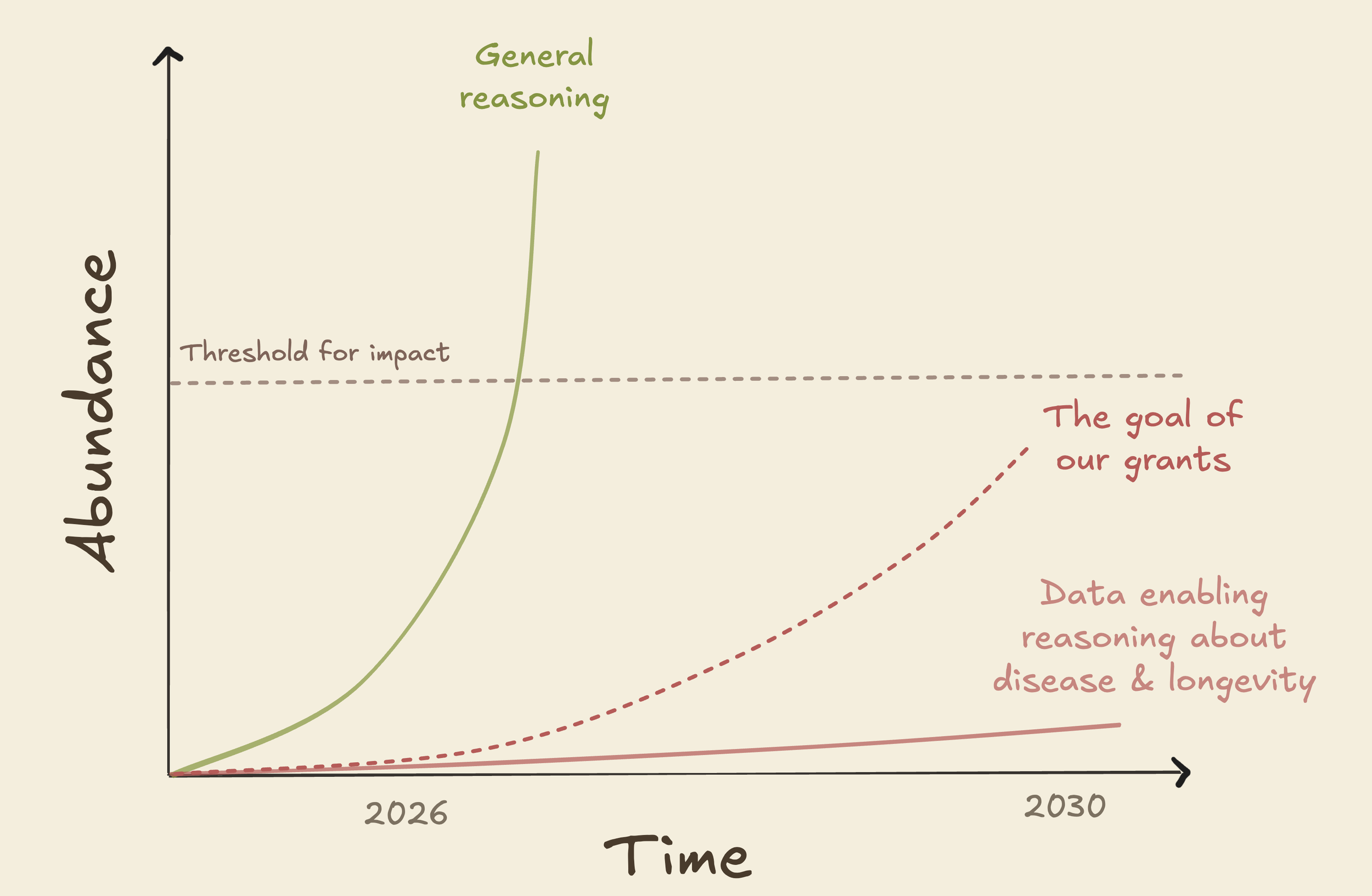
Computational intelligence is becoming abundant, but breakthroughs in medicine will only follow if we also have high quality data relevant to human disease. AlphaFold accelerated progress in protein folding thanks to strong ground truth data from crystallography. The equivalent data for curing disease is not molecular, but changes in the behavior of organs and organisms over time.
This focused round of Impetus Grants will ensure that we are generating the right data for the longevity field to benefit from advances in AI. Good inference will need to be trained on datasets that span both organ-level outcomes, and interventions or time course measurements that allow causal interactions to be identified and treatments to be proposed.
Why this matters
We have a lot of data on molecules and cells, but an organ is not a linear sum of its cells. Because we cannot even measure all the component molecules/cells at once, let alone their interactions and feedback loops, we cannot infer the causes or solutions to complex diseases from molecular or cellular data alone. So although we will increasingly automate and simulate experiments at the molecular and cellular level, extending this to new medicines will be limited by the time it takes to collect matching and hypothesis-testing data from organs and organisms.
We build datacenters now to meet anticipated compute demand. The same logic applies to data. If we want AI to move the needle on longevity therapies as early as possible, we should prioritize collecting the most obviously valuable datasets that cannot be accelerated. By default, AI will accelerate progress at the biological layers we already measure well, while the breakthroughs longevity needs live at the layers we don't. Read the full case from Longevity Industrialized: “Ask not what AI can do for longevity. Ask what the longevity field can do for AI."
Examples that would be worth funding include:
Adding high-dimensional measurements to intervention trials and other human longitudinal samples that have already been collected.
Large-scale perturbation experiments inside living organisms to map the responses of cells in the presence of interactions and feedback from a diseased organ.
Tools that allow us to measure more biology in commonly collected samples, e.g. blood draws, to make better use of ongoing human studies.
Setting up an adaptive human trial that could continuously test hypotheses from AI. Such designs have been used before, but take considerable time to set up.
Why is an Impetus round needed?
Most research grants still assume that the next five years will be roughly like the last five, but given the pace of progress in AI that is unlikely to be the case. There’s a timely opportunity for grantmaking that understands both this development, and what the most important questions and required datasets in longevity are. We will combine reviewers in bio and AI, and require that resulting data is open-source and formatted for immediate ingestion by major AI model architectures.
Making it happen
We’re aiming to raise $15M to award ~50 grants. The first $5M of new commitments will be matched 1:1 by Robert Rosenkranz, our anchor donor.
If you're a funder considering an ambitious longevity bet, or you can introduce us to one, please reach out to Martin directly. He'll walk you through the round, the science we're prioritizing, and how matched dollars compound impact.
Major Patrons











Latest Updates
Program History
What if longevity research moved like emergency science? That question came up at a 2021 conference in Colorado, and by the end of the day it had an answer: a grant program designed from scratch to fund bold ideas fast, with no score-by-committee and no hundred-page applications.

Principles
Ambitious science
We fund work that could change the trajectory of aging research, not incremental additions to existing knowledge. Our review process is structured to surface bold ideas: individual reviewers can champion projects without requiring committee consensus, avoiding the dilution that often filters out unconventional approaches.
Leveraged impact
Impetus focuses on work that is too speculative for government funding and too early for company formation. Many of today’s most influential areas in longevity science, such as partial cellular reprogramming and epigenetic clocks, emerged without NIH support. We operate in that gap and bring exceptional scientists into aging who might not otherwise enter the field.
Efficient resourcing
Applications are short, decisions are made within three weeks, and organizational overhead has remained ~1.1%. This minimizes wasted time and maximizes the share of resources going directly to research.
Want to get notified for future Impetus rounds, Norn updates, and the occasional dispatch on what we're learning about longevity?
Sign up for our newsletter here: